No gym. No dumbbells. No excuses.
Bodyweight HIIT exercises are one of the most effective ways to burn fat, build functional strength, and improve cardiovascular fitness — and you can do them in your living room with nothing but a few square feet of floor space. Research from the University of Wisconsin found that bodyweight high-intensity circuits burn approximately 15 calories per minute, making them as effective as many equipment-based workouts.
Here are the 10 best bodyweight exercises for beginners starting HIIT, with modifications for every fitness level.
Why Bodyweight HIIT Works
Before diving into the exercises, it's worth understanding why this approach is so effective.
The landmark 2013 ACSM study by Klika and Jordan established that high-intensity circuit training using body weight delivers "maximum results with minimal investment." Their 12-exercise bodyweight protocol — performed for 30 seconds each with 10 seconds of rest — improved both aerobic and muscular fitness in just 7 minutes per session.
More recent research confirms this. A 2025 study in Sports (Basel) found that high-intensity circuit training produced nearly identical EPOC (afterburn) and fat oxidation as traditional HIIT — the format doesn't matter as much as the intensity. And a pilot study on no-load resistance training published in PMC demonstrated that exercises performed with no external load can still produce high levels of peak muscle activation, confirming that your body weight provides sufficient resistance when combined with intensity.
The bottom line: equipment is optional. Effort is not.
The 10 Best Bodyweight HIIT Exercises
1. Bodyweight Squats
The foundation of lower-body training. Squats target your quads, glutes, and hamstrings while engaging your core for stability.
How to do it: Stand with feet shoulder-width apart. Push your hips back and bend your knees until your thighs are parallel to the floor. Drive through your heels to stand.
Beginner modification: Use a chair for support — squat down until you lightly touch the seat, then stand back up.
2. Push-Ups
The gold standard for upper-body bodyweight training. Push-ups work your chest, shoulders, triceps, and core simultaneously.
How to do it: Start in a high plank position, hands just wider than shoulder-width. Lower your chest to the floor, keeping elbows at 45 degrees. Push back up.
Beginner modification: Perform on your knees, or do incline push-ups with hands on a bench or step.
3. High Knees
A high-output cardio exercise that drives your heart rate up fast while working your hip flexors, quads, and core.
How to do it: Run in place, driving each knee to hip height. Pump your arms to match.
Beginner modification: March in place with exaggerated knee lifts instead of running.
4. Mountain Climbers
A full-body cardio exercise that combines plank strength with explosive leg drive. Mountain climbers have a MET value of 11.0 — placing them among the most metabolically demanding bodyweight exercises in the 2024 Compendium of Physical Activities.
How to do it: Start in a high plank position. Drive one knee toward your chest, then quickly switch legs in a running motion.
Beginner modification: Slow the pace — step each foot forward deliberately instead of running.
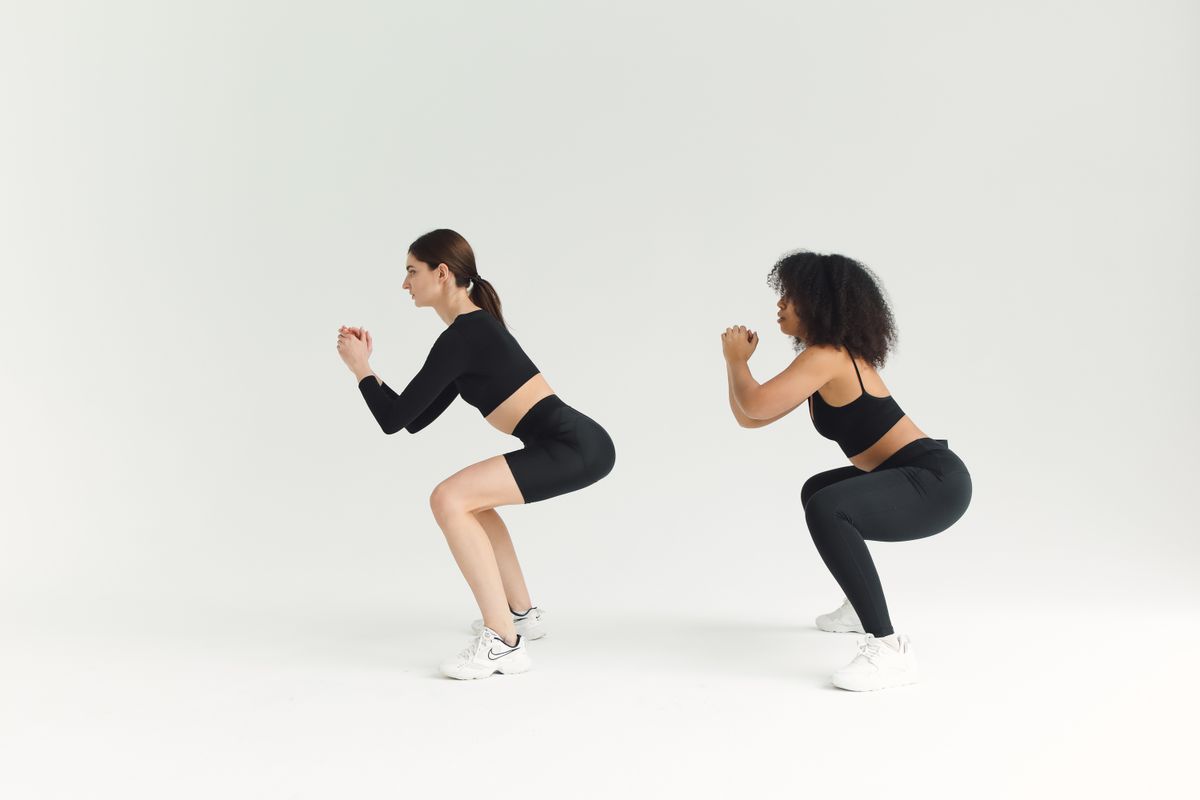 Women doing bodyweight squats together during a workout session
5. Jump Squats
An explosive progression from the bodyweight squat. Jump squats build power in your quads and glutes while spiking your heart rate. They burn approximately 8–12 calories per minute at moderate-to-high intensity.
How to do it: Perform a bodyweight squat, then explode upward into a jump. Land softly with bent knees and immediately drop into the next squat.
Beginner modification: Skip the jump. Perform regular bodyweight squats at a fast, controlled pace and rise onto your toes at the top.
6. Burpees
The most demanding bodyweight exercise — and one of the most effective. Burpees engage your chest, shoulders, core, quads, glutes, and arms in a single movement, burning approximately 10–15 calories per minute.
How to do it: From standing, drop into a squat, place your hands on the floor, jump your feet back into a plank, perform a push-up, jump your feet forward, and explode into a jump.
Beginner modification: Replace with squat-to-stands. Squat down, place your hands on the floor, step (not jump) your feet back one at a time, step forward, and stand. No push-up, no jump.
7. Reverse Lunges
A knee-friendly alternative to forward lunges that targets your glutes, quads, and hamstrings while challenging your balance.
How to do it: Step one foot back and lower your back knee toward the floor until both legs form 90-degree angles. Push through your front heel to return to standing. Alternate legs.
Beginner modification: Hold onto a wall or chair for balance support.
8. Plank Jacks
A dynamic core exercise that combines the stability demands of a plank with the cardio stimulus of jumping jacks.
How to do it: Start in a high plank position. Jump your feet wide apart, then jump them back together — like a horizontal jumping jack.
Beginner modification: Step one foot out at a time instead of jumping.
9. Jumping Jacks
A classic full-body cardio exercise that elevates your heart rate quickly with minimal coordination demands — making it one of the most beginner-friendly HIIT moves.
How to do it: Stand with feet together and arms at your sides. Jump your feet wide while raising your arms overhead. Jump back to the starting position.
Beginner modification: Do step jacks — step one foot out at a time instead of jumping, and keep the arm movement.
10. Glute Bridges
A low-impact posterior chain exercise that strengthens your glutes and hamstrings. Glute bridges make an excellent active recovery exercise within a HIIT circuit.
How to do it: Lie on your back with knees bent and feet flat on the floor. Drive your hips toward the ceiling, squeezing your glutes at the top. Lower with control.
Beginner modification: This exercise is already beginner-friendly. To increase difficulty, try single-leg glute bridges or add a pause at the top.
Calorie Burn Comparison
Not all bodyweight exercises are created equal. Here's how the top moves compare for a 155 lb (70 kg) person:
Free on iOS
TRAIN SMARTER
Build custom HIIT, Tabata, AMRAP, EMOM and Circuit workouts. Precision timer, streak tracking and analytics — free on iOS.
| Exercise | Calories/Min | MET Value | Primary Muscles |
|---|---|---|---|
| Burpees | 10–15 | ~10–12 | Full body |
| Mountain climbers | 8–15 | ~8–11 | Core, shoulders, legs |
| Jump squats | 8–12 | ~8 | Quads, glutes, hamstrings |
| High knees | 8–10 | ~8 | Hip flexors, quads, core |
| Jumping jacks | 7–10 | ~7 | Full body (lower intensity) |
| Push-ups | 5–8 | ~5–6 | Chest, shoulders, triceps |
| Bodyweight squats | 5–7 | ~5.5 | Quads, glutes |
The highest-calorie exercises are the explosive, full-body movements. But a well-designed HIIT circuit alternates between high-output moves and strength-focused exercises to keep your heart rate elevated while giving specific muscle groups time to recover.
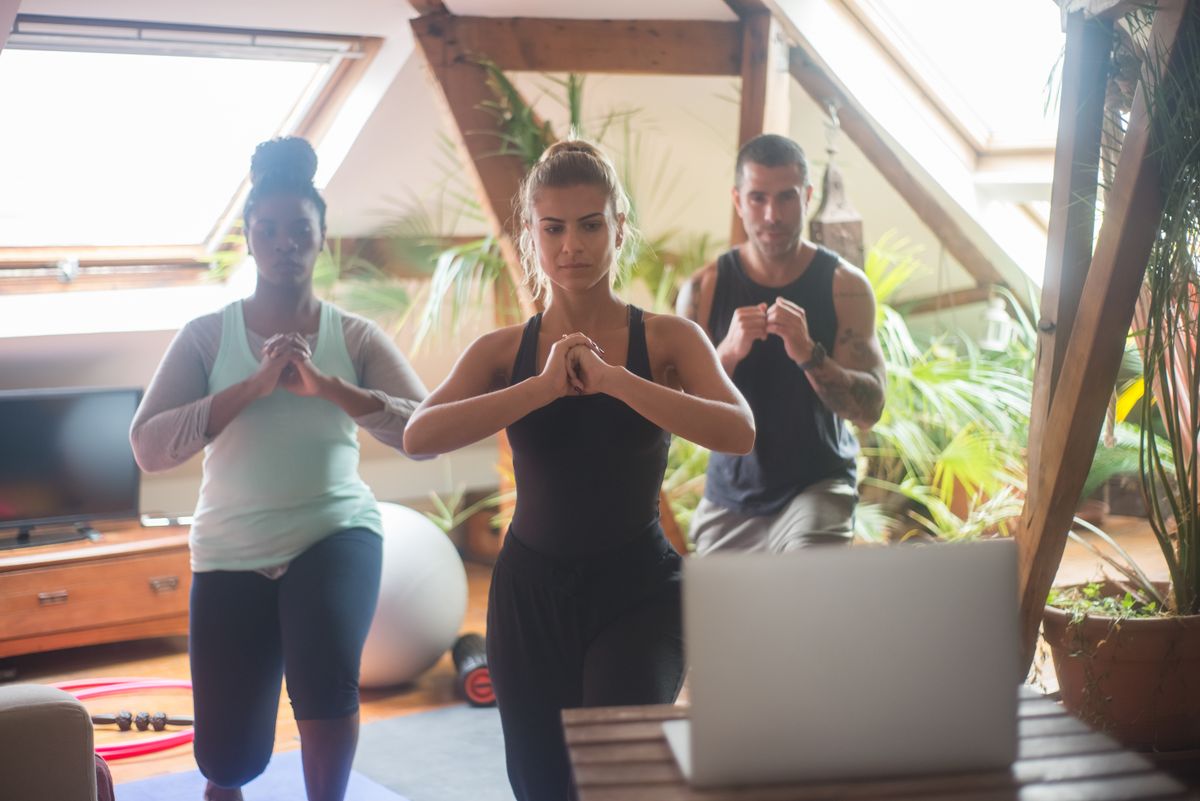 Women and man exercising together at home during a bodyweight workout
Sample 15-Minute Beginner Workout
Ready to put it together? Here's a complete no-equipment HIIT workout using exercises from this list.
Format: 20 seconds work / 40 seconds rest. 5 exercises. 3 rounds.
Round 1–3:
- Bodyweight squats — 20 sec work / 40 sec rest
- Push-ups (modified if needed) — 20 sec work / 40 sec rest
- High knees (or marching) — 20 sec work / 40 sec rest
- Reverse lunges (alternating) — 20 sec work / 40 sec rest
- Glute bridges — 20 sec work / 40 sec rest
Rest 60 seconds between rounds.
Total time: ~15 minutes including rest.
4-Week Progression
As your fitness improves, progress the work-to-rest ratio:
- Week 1–2: 20 sec work / 40 sec rest (2 rounds)
- Week 3–4: 25 sec work / 35 sec rest (3 rounds)
- Week 5–6: 30 sec work / 30 sec rest (3 rounds)
- Week 7+: 30 sec work / 15 sec rest (4 rounds) — swap in explosive variations (jump squats, burpees)
Track Your Bodyweight HIIT With Hiitify
A good interval timer makes bodyweight HIIT effortless. Hiitify lets you build custom workouts with precise work and rest intervals, add exercises with notes and modifications, and follow along with audio countdown and voice cues — so you can focus on the movement, not the clock. Save your workouts, replay them anytime, and track your training streak to stay consistent.
Free on iOS
TRAIN SMARTER
Build custom HIIT, Tabata, AMRAP, EMOM and Circuit workouts. Precision timer, streak tracking and analytics — free on iOS.
Sources & Further Reading
Research
-
Klika, B. & Jordan, C. (2013). High-Intensity Circuit Training Using Body Weight: Maximum Results With Minimal Investment. ACSM's Health & Fitness Journal, 17(3), 8–13. View on ACSM
-
Faleiro, V. et al. (2025). Isocaloric High-Intensity Interval and Circuit Training Increases Excess Post-Exercise Oxygen Consumption and Lipid Oxidation Compared to Moderate-Intensity Continuous Training. Sports (Basel). View on PMC · View on PubMed
-
Ribeiro, A. et al. (2020). "NO LOAD" Resistance Training Promotes High Levels of Knee Extensor Muscles Activation — A Pilot Study. PMC. View on PMC
-
Falcone, P.H. et al. (2015). Caloric expenditure of aerobic, resistance, or combined high-intensity interval training using a hydraulic resistance system in healthy men. Journal of Strength and Conditioning Research. View on PubMed
Further Reading
- HIIT For Beginners: 18 Exercises, 5 Workouts & Training Tips — SET FOR SET
- HIIT Workouts At Home: 9 Proven Routines (No Equipment) — Marathon Handbook
- Body Weight Exercises You Can Do Anywhere — Washington Post
Image Credits
- Cover: Woman performing a push-up — Pexels
- Women doing squats during workout — Pexels
- Women and man exercising at home — Pexels
All images free to use under the Pexels License.