Your core does not exist to crunch you forward. Its primary job is to stabilize your spine — to resist movement, transfer force between your upper and lower body, and protect your back during everything from lifting groceries to sprinting. Sit-ups train the opposite pattern, and research shows they may do more harm than good. Here is how to build real core strength without sit-ups, backed by science.
Why Sit-Ups Are Not the Best Core Exercise
For decades, sit-ups were the default core exercise. But research from Dr. Stuart McGill, Professor Emeritus of Spine Biomechanics at the University of Waterloo, changed that.
McGill's lab measured the compressive forces on the lumbar spine during a traditional sit-up: approximately 3,400 newtons — roughly 340 kilograms of pressure on your spinal discs. The U.S. National Institute for Occupational Safety and Health (NIOSH) sets the safety threshold at 3,300 newtons. Every rep exceeds it.
The problem is not just force — it is repeated spinal flexion under load. Over hundreds of reps, this pattern can compress the disc nucleus to the point where it bulges, pressing on nerves and potentially causing herniation. This is why the U.S. military, the Canadian Armed Forces, and most physical therapy guidelines have moved away from sit-ups as a fitness test and training tool.
Sit-ups also miss most of the core. They primarily target the rectus abdominis and hip flexors, while the muscles responsible for real-world stability — the transverse abdominis, multifidus, obliques, and pelvic floor — are barely engaged.
What Your Core Actually Does
Your core is not one muscle. It is a cylinder of muscles surrounding your lumbar spine:
| Muscle | Location | Function |
|---|---|---|
| Rectus abdominis | Front | Spinal flexion (the "six-pack") |
| Transverse abdominis | Deep front | Compresses abdomen, stabilizes spine |
| Internal and external obliques | Sides | Rotation, lateral flexion, bracing |
| Multifidus | Deep back | Segmental spinal stability |
| Erector spinae | Back | Spinal extension, posture |
| Quadratus lumborum | Deep sides | Lateral stabilization |
| Diaphragm | Top | Breathing, intra-abdominal pressure |
| Pelvic floor | Bottom | Base support, pressure regulation |
Research shows the transverse abdominis and multifidus co-contract before any limb movement occurs — they fire anticipatorily to stiffen the spine. Effective core training targets this stabilizing function, not just the surface-level rectus abdominis.
 Woman performing a side plank on a yoga mat
Free on iOS
TRAIN SMARTER
Build custom HIIT, Tabata, AMRAP, EMOM and Circuit workouts. Precision timer, streak tracking and analytics — free on iOS.
The Best Core Exercises Without Sit-Ups
These exercises are organized by the type of stability they train. A complete core routine includes at least one from each category.
Anti-Extension: Front Plank
The plank trains your core to resist spinal extension — the tendency for your lower back to sag under gravity or load. Hold a straight line from head to heels, bracing your abs as if you are about to be pushed.
Start with: 3 sets of 20–30 seconds. Progress by adding 5-second holds, not by going past 60 seconds — research shows diminishing returns beyond that.
Anti-Lateral Flexion: Side Plank
Part of McGill's Big Three, the side plank builds lateral trunk stability, which is critical for spine protection. A 2014 systematic review in Sports Health supports its role in reducing lower back pain.
Start with: 2–3 sets of 15–20 seconds per side.
Anti-Rotation: Bird Dog
Ultrasound imaging shows the bird dog significantly activates deep core stabilizers, including the multifidus and transverse abdominis. Extend one arm and the opposite leg while keeping your hips and shoulders perfectly level — the challenge is resisting the rotational pull.
Start with: 3 sets of 8 reps per side, holding each rep for 5 seconds.
Coordinated Bracing: Dead Bug
The dead bug reinforces core bracing and lumbar stability without any spinal compression. Lying on your back, you extend opposite limbs while pressing your lower back into the floor — training the exact pattern your core uses during walking, running, and lifting.
Start with: 3 sets of 8 reps per side, slow and controlled.
Hip-Core Integration: Glute Bridge
Your glutes are part of the core system. Weak glutes force the lower back to compensate, which is a leading cause of lumbar pain. The glute bridge strengthens the posterior chain while teaching your hips and core to work together.
Start with: 3 sets of 12–15 reps, squeezing at the top for 2 seconds.
A Simple Weekly Core Routine
You do not need a long session. A focused 10- to 15-minute circuit performed two to three times per week is enough to build meaningful core strength.
| Exercise | Sets | Reps or Duration | Category |
|---|---|---|---|
| Front plank | 3 | 20–30 seconds | Anti-extension |
| Side plank (each side) | 2 | 15–20 seconds | Anti-lateral flexion |
| Bird dog (each side) | 3 | 8 reps (5-second hold) | Anti-rotation |
| Dead bug (each side) | 3 | 8 reps | Coordinated bracing |
| Glute bridge | 3 | 12–15 reps | Hip-core integration |
Rest 30 seconds between sets. As you get stronger, progress by adding a Pallof press (cable or band anti-rotation hold) and replacing the standard plank with a plank shoulder tap or body saw.
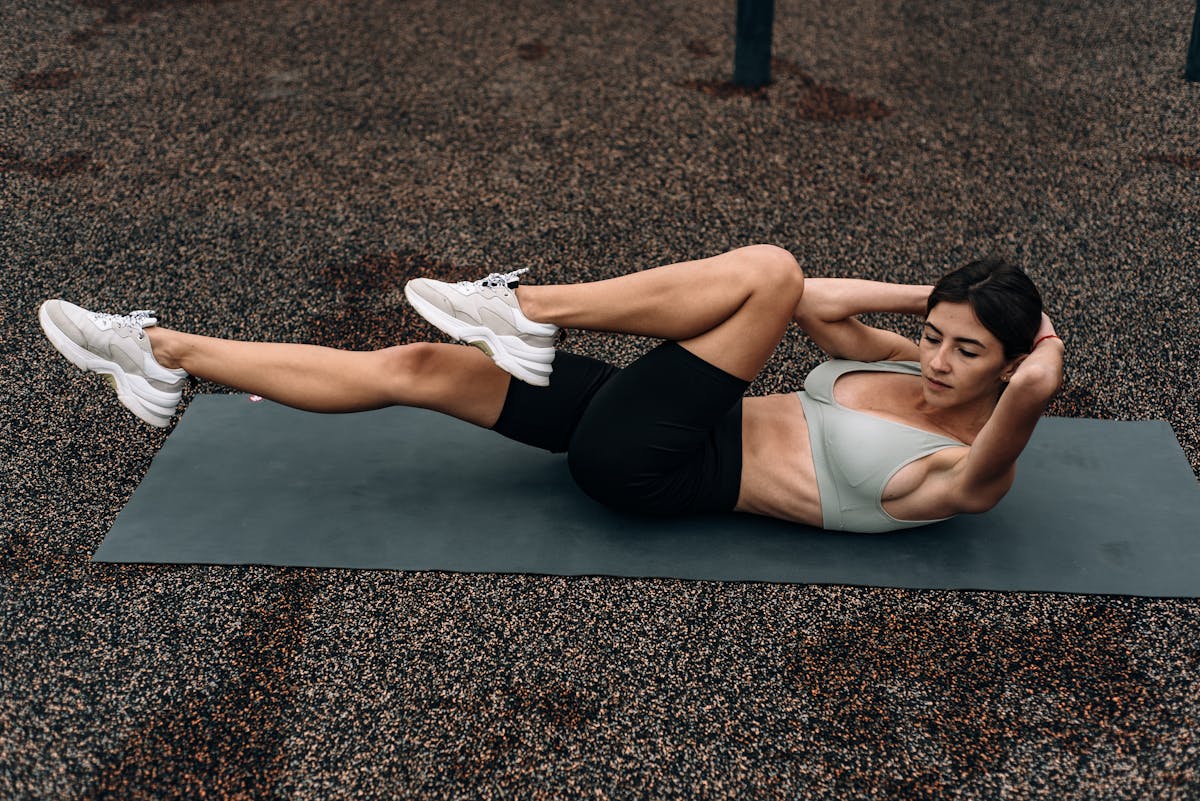 Woman performing an ab exercise on an exercise mat outdoors
What the Research Says About Results
A 2024 study published in Frontiers in Physiology found that core stability training protocols — using exercises like planks, bird dogs, and dead bugs — produced significant improvements in muscle hypertrophy, balance, and quality of life in recreationally active adults over 12 weeks.
McGill's own research emphasizes that core endurance, not maximum strength, is the variable most associated with spinal health. People with chronic lower back pain consistently show reduced endurance in their stabilizing muscles, not reduced peak force. Training the core to hold and resist — not to crunch — addresses the actual deficit.
A meta-analysis examining 22 studies with over 3,200 participants found that exercises challenging stability while reinforcing movement patterns yielded better athletic performance outcomes than traditional flexion-based core exercises like sit-ups and crunches.
Track Your Core Training With Hiitify
Hiitify's customizable interval timer is built for exactly this kind of training. Set up timed holds for planks and side planks, program work-rest intervals for bird dogs and dead bugs, and track every core session with workout logging. Build a streak, see your consistency grow, and progress your holds and reps over time — all without a single sit-up.
Free on iOS
TRAIN SMARTER
Build custom HIIT, Tabata, AMRAP, EMOM and Circuit workouts. Precision timer, streak tracking and analytics — free on iOS.
Sources & Further Reading
Research
- McGill, S.M. (2010). Core Training: Evidence Translating to Better Performance and Injury Prevention. Strength and Conditioning Journal. View on ResearchGate
- Huxel Bliven, K.C. & Anderson, B.E. (2013). Core Stability Training for Injury Prevention. Sports Health. View on PMC
- Chang, W.D. et al. (2019). The Critical Role of Development of the Transversus Abdominis in the Prevention and Treatment of Low Back Pain. HSS Journal. View on PMC
- Amorim, S. et al. (2024). Development and Implementation of a Core Training Protocol: Effects on Muscle Activation, Hypertrophy, Balance, and Quality of Life. Frontiers in Physiology. View on PMC
- Callaghan, J.P. & McGill, S.M. (2001). Intervertebral disc herniation: studies on a porcine model exposed to highly repetitive flexion/extension motion with compressive force. Clinical Biomechanics. View on PubMed
Further Reading
- Low Back Exercises: Stuart McGill's Big Three — ACE Fitness
- The McGill Big 3 For Core Stability — Squat University
- How to Strengthen Your Core Without a Single Sit-Up — Physiophyx
Image Credits
- Cover: Woman Planking on Yoga Mat Outdoors — Pexels
- Woman Performing Side Plank on Mat — Pexels
- Woman Performing Ab Exercise Outdoors — Pexels
All images free to use under the Pexels License.