Two of the most popular workout formats in fitness — and two of the most confused. Circuit training and HIIT both promise efficient, full-body workouts that burn serious calories. But they're not the same thing, and depending on your goals, one may serve you better than the other.
Here's what the science actually says about circuit training vs HIIT for fat loss, muscle building, and overall fitness.
What's the Difference?
The distinction is simpler than most fitness sites make it.
HIIT (High-Intensity Interval Training) alternates short bursts of near-maximum effort with brief rest periods. The defining feature is intensity — you work at 80–95% of your max heart rate during the "on" intervals. Common formats include Tabata (20s on / 10s off) and classic intervals (30s on / 15s off).
Circuit training rotates through a series of exercises performed back-to-back with minimal rest between moves and a longer rest between rounds. The defining feature is structure — you move from station to station, hitting different muscle groups. Intensity can range from moderate to high depending on the design.
The overlap? Plenty. A high-intensity circuit is functionally very close to HIIT. But a traditional circuit at moderate pace is a different animal entirely.
| HIIT | Circuit Training | |
|---|---|---|
| Intensity | 80–95% max HR | Moderate to high |
| Work intervals | 10–60 seconds | 30–60 seconds per station |
| Rest | Fixed, short (10–30s) | Minimal between exercises, 1–2 min between rounds |
| Exercises per session | 1–4 | 6–12 |
| Primary goal | Cardio + fat loss | Strength + conditioning |
| Duration | 15–30 min | 20–40 min |
The Calorie Burn: What the Numbers Say
This is usually the headline question — which format burns more calories?
HIIT burns more calories per minute when performed at true high intensity. A 2015 study by Falcone et al. in the Journal of Strength and Conditioning Research measured trained men burning approximately 12.6 kcal/min during a 30-minute HIIT session. That's roughly 25–30% more than moderate-intensity continuous exercise.
Circuit training burns fewer calories per minute at moderate intensity — estimates range from 6–10 kcal/min depending on the exercises and load. However, a 2019 meta-analysis of nine randomised controlled trials found that circuit training interventions produced an average weight loss of 3.81 kg and a BMI reduction of 1.77 kg/m² in overweight participants.
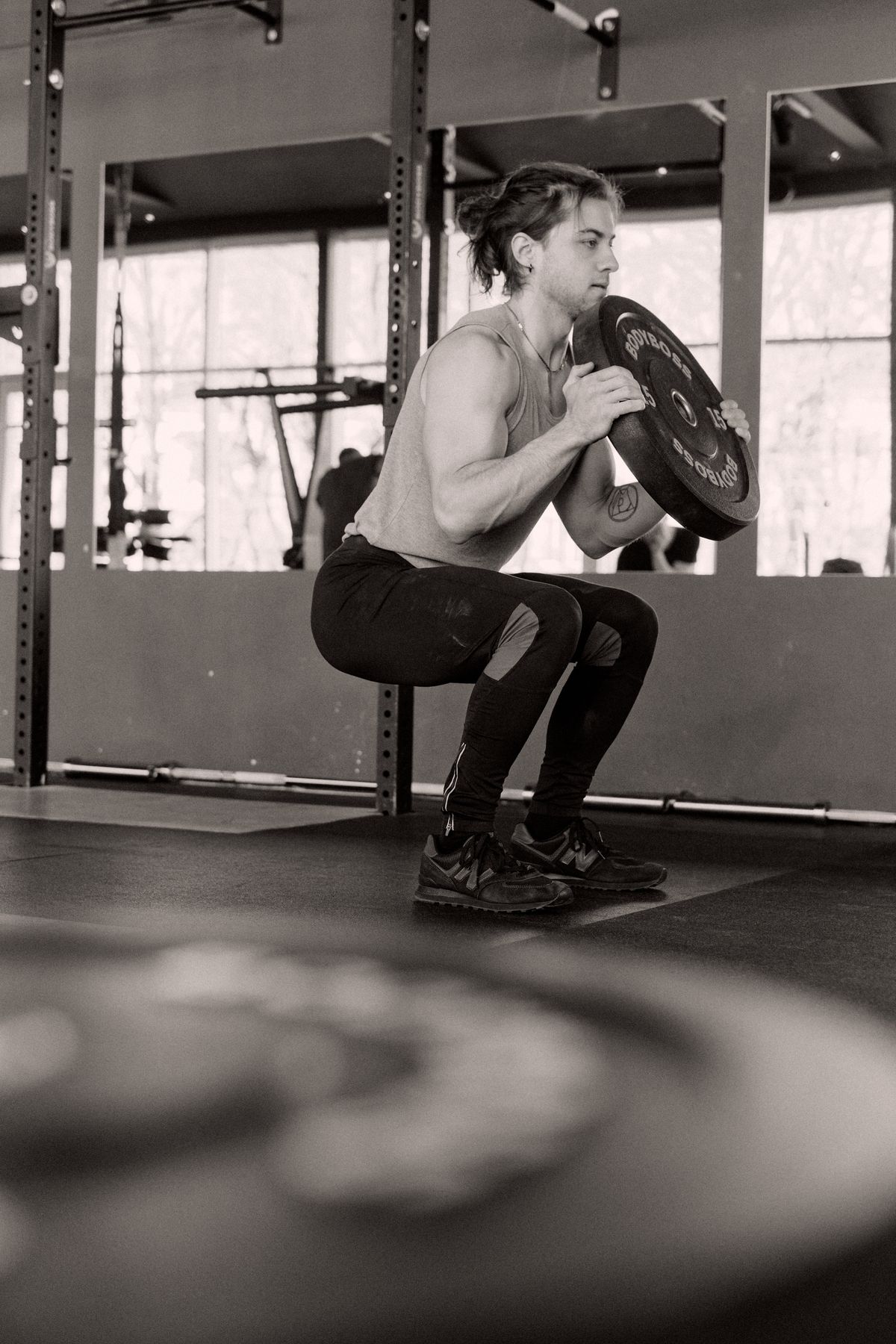 Man doing squats with a weight plate during a circuit training workout at the gym
The key insight: total calorie burn over a week matters more than calorie burn per minute. If circuit training lets you work out four times a week because recovery is manageable, while HIIT limits you to two or three sessions, the weekly totals may be closer than you'd expect.
The Afterburn Effect: HIIT vs Circuit Training
The afterburn effect — technically called EPOC (Excess Post-Exercise Oxygen Consumption) — is one of the most discussed advantages of high-intensity training. After intense exercise, your body continues burning calories at an elevated rate as it returns to its resting state.
Free on iOS
TRAIN SMARTER
Build custom HIIT, Tabata, AMRAP, EMOM and Circuit workouts. Precision timer, streak tracking and analytics — free on iOS.
A landmark 2025 study published in Sports (Basel) directly compared HIIT, high-intensity circuit training (HICT), and moderate-intensity continuous training (MICT) in an isocaloric design — meaning all three groups burned the same number of calories during their sessions. The results were striking:
- EPOC was nearly double for HIIT (319.0 mL) and HICT (329.1 mL) compared to MICT (168.5 mL)
- Lipid oxidation (fat burning) at 30 minutes post-exercise was significantly higher in both HIIT and HICT groups
- These effects persisted for at least 60 minutes after training
The critical finding: high-intensity circuit training matched HIIT almost exactly on every post-exercise metric. The difference isn't the format — it's the intensity. Push a circuit hard enough and you get the same afterburn as HIIT.
Muscle Building: Where Circuit Training Wins
This is circuit training's strongest advantage. Because circuits incorporate resistance exercises — squats, push-ups, lunges, rows, deadlifts — they provide a meaningful muscle-building stimulus that pure HIIT often lacks.
Research shows that circuit training induces the same anabolic signalling and maximal muscle fibre recruitment as conventional resistance training, but without needing as much weight — because the shortened rest periods create additional metabolic stress.
 Man lifting a kettlebell during an intense workout, showcasing strength and explosive power
A systematic review and meta-analysis on resistance circuit training in older adults found it reduced body fat by an average of 5.39 kg while simultaneously increasing lean body mass by 1.42 kg. That's the dual benefit: losing fat and gaining muscle at the same time.
HIIT is excellent for cardiovascular conditioning, but most HIIT protocols use bodyweight or light exercises that don't provide sufficient progressive overload for significant muscle growth. If body composition — not just weight loss — is your goal, circuit training has the edge.
Cardiovascular Fitness: Where HIIT Wins
HIIT's specialty is cardiovascular adaptation. The high-intensity intervals push your heart rate to near-maximum, forcing rapid adaptation in both the aerobic and anaerobic energy systems.
A 2024 Frontiers in Endocrinology study comparing Tabata, HIIT, and moderate-intensity continuous training found that HIIT produced an energy expenditure rate of 4.81 kcal/min with significantly greater improvements in metabolic markers than steady-state exercise.
Circuit training also improves cardiovascular fitness — a meta-analysis found it can improve VO₂max by 6.2% — but HIIT typically delivers larger cardiovascular gains in less time. If your primary goal is aerobic and anaerobic capacity, HIIT is the more efficient path.
Who Should Choose What?
There's no universal winner. The best choice depends on your goals, fitness level, and schedule.
Choose circuit training if you want to:
- Build muscle while losing fat
- Train 3–4 times per week with manageable recovery
- Develop full-body strength and endurance simultaneously
- Follow a structured workout with clear exercise rotation
Choose HIIT if you want to:
- Maximise calorie burn in minimum time
- Improve cardiovascular fitness rapidly
- Train in 15–20 minute sessions
- Push your limits with near-maximum effort
Combine both if you want to:
- Get the best of both worlds
- For example: 2 HIIT sessions + 2 circuit sessions per week
- Use circuits for strength days and HIIT for pure cardio days
 Young athlete recovering after an intense training session at the gym
A Side-by-Side Sample Workout
Here's what each format looks like in practice — same 20-minute time commitment, very different approaches.
HIIT — 20 minutes
- 30 seconds burpees / 15 seconds rest
- 30 seconds mountain climbers / 15 seconds rest
- 30 seconds jump squats / 15 seconds rest
- 30 seconds high knees / 15 seconds rest
- Rest 60 seconds. Repeat 4 times.
Circuit — 20 minutes
- 12 goblet squats
- 10 push-ups
- 12 dumbbell rows (each arm)
- 10 reverse lunges (each leg)
- 15 mountain climbers (each side)
- 10 shoulder presses
- Rest 90 seconds. Repeat 3 times.
The HIIT session is pure cardio intensity. The circuit builds strength across every major muscle group. Both are effective — they just target different outcomes.
Build Both Workouts With Hiitify
Whether you're building a HIIT timer or designing a multi-exercise circuit, Hiitify handles both formats. Set your work and rest intervals, add exercises with rep targets, and let the app manage the clock with audio cues — so you can focus on training, not timekeeping.
Free on iOS
TRAIN SMARTER
Build custom HIIT, Tabata, AMRAP, EMOM and Circuit workouts. Precision timer, streak tracking and analytics — free on iOS.
Sources & Further Reading
Research
-
Falcone, P.H. et al. (2015). Caloric expenditure of aerobic, resistance, or combined high-intensity interval training using a hydraulic resistance system in healthy men. Journal of Strength and Conditioning Research. View on PubMed
-
Faleiro, V. et al. (2025). Isocaloric High-Intensity Interval and Circuit Training Increases Excess Post-Exercise Oxygen Consumption and Lipid Oxidation Compared to Moderate-Intensity Continuous Training. Sports (Basel). View on PMC · View on PubMed
-
Sonchan, W. et al. (2019). Weight loss effects of circuit training interventions: A systematic review and meta-analysis. View on PubMed
-
Li, X. et al. (2024). Effect of resistance circuit training on comprehensive health indicators in older adults: a systematic review and meta-analysis. View on PMC
-
Wang, S. et al. (2024). A comparative analysis of energy expenditure and substrate metabolism: Tabata vs HIIT and MICT. Frontiers in Endocrinology. View on Frontiers
Further Reading
- Fitness Debate: Circuit Training vs HIIT — ISSA
- Circuit Training vs HIIT: Which Is Right for You? — Centr
- Circuit Training vs HIIT for Fitness and Fat Loss — Fitness Volt
Image Credits
- Cover: Women exercising — Pexels
- Man doing squats at the gym — Pexels
- Man lifting a kettlebell — Pexels
- Young athlete recovering after training — Pexels
All images free to use under the Pexels License.